Showing posts with label Tracy Jones. Show all posts

Tuesday, 6 July 2010

Cupcakes & Conversation with Russell Ducker, Corp de Ballet, Corella Ballet

Cupcakes & Conversation with Russell Ducker, Corp de Ballet, Corella Ballet

Today I had completely the scariest experience of my life; at least on a par with nearly drowning as a child.  So the calming influence of 'Cupcakes & Conversation' has never been more essential.  I'm delighted to bring you the charming, talented and witty Russell Ducker, who recently created his first ballet - 'Epimetheus'. Like me, I'm sure you'd like to see his ballet danced in the UK (and around the world - though you lucky New Yorkers already had that chance !), but we may have to start a campaign to make it happen... we've done it before.  Enjoy !

What motivates you at 8am on a Monday morning ?
The ‘right’ answer is; “a new week, with all the possibilities to better myself as an artist”. To my disgrace, I am certainly not a morning person. In fact, I am barely myself until about 10 o’clock. Before that time I am a grumpy, slow moving mass - who should be avoided at all costs. It verges on the Jekyll and Hyde.

So what motivates me at 8am...very little. I have started yoga in order to earnestly conquer this shaming quality. It seems to really be helping. Focusing on breath control and slow, increasing stretches, it helps me focus for the day ahead and also prepares my body for class.

Who would you most like to dance with & what would you dance ?
There are so many fantastic female dancers out there at the moment, it would be unfair to choose. Maybe my mum...she can’t dance to save her life but it would hilarious to see her try. As a role, Romeo is probably the ultimate challenge for a male artist. The plot line is so beautifully painful, that it never tires me. I would relish the exploration of interpreting such a legendary character.

If you could dance anywhere in the world (not only in a theatre), where would you dance ?
Anywhere and everywhere. I am very happy dancing in Spain, but perhaps in the future I would like to come home to the UK. Hopefully again in the US. The audiences were insane, I could definitely get used to that.

What is your daily routine at the moment ?
Our days tend to vary quite a lot, depending on whether we are in the studios, on the road or performing. At the moment we are rehearsing a compilation of company repertoire. The reason being, we are scheduled in approaching performances to present a combination of ballets from 2008/09 and this year's season. So a lot is going on. Plus we are performing Swan Lake again very soon. After a day of heavy rehearsal, I am roping people in to help me hone my choreographic skills. My latest work, ‘Sospiri’ a variation for my colleague Tracy Jones will hopefully be featured on my website very soon. Secretly that is the highlight of my day. Discovering the elements needed to perfect the choreographic process.

Russell in the studio with Carla Lopez, rehearsing Christopher Wheeldon's 'VIII'
Photograph : Fernando Bufala

How do you prepare in the hours before a show ?
I've learned to stay as calm as possible. I have a lot of nervous energy so its important for me to manage that. I encourage myself to maintain a creative frame of mind. I might read a book, or if I’m playing a role I will specify to myself the details of who I am about to become. I start my make up an hour before, then I warm up for 1/2 hour onstage, and practice various steps by myself or with my partner. I like to familiarize myself with the space. Dancing on new stages all the time, new surroundings can be distracting.

What are you looking forward to dancing in 2010 ?
The company has a great, diverse repertoire, from world class choreographers. This season we are scheduled to perform ‘Raymonda’ and ‘For Four’ as part of our triple bill, alongside DGV. Which I have adored dancing. So I am looking forward to continue working on that. I have always been a big fan of
Christopher Wheeldon’s so it is a privilege to dance in such a special piece. In Swan Lake I have been cast to learn the Neapolitan dance and Benno. So the opportunity to have a crack at either of those would be a great challenge. Fingers crossed.

You can ask six famous people to dinner - who would you invite ?
Kenneth MacMillan, Fred Astaire, Dawn French, Forsythe, Barack Obama, and Meryl Streep.

Tracy Jones in Russell Ducker's Epimetheus

What would surprise people about you ?
How stubborn I can be.

Who inspired you to dance ?
It wasn't really a particular person, although I grew up fascinated by old Hollywood movies and the likes of Gene Kelly and Fred Astaire. I would describe it as just a simple magnetic attraction to the stage. Anything I was ever good at steered me in that direction. I was always a fan of Angel (ed : Angel Corella, dancer with American Ballet Theatre and Corella Ballet, and Artistic Director of Corella Ballet), so it is fitting that I should end up in his company.

How would someone else describe you ?
Probably ease going, loyal, at times paranoid. I tend to surprise people.

What is your best piece of advice ?
Follow your gut. never be swayed by other people and have faith that it will come together at the end. Also to make yourself heard and seen. I have to remind myself of this often.

Russell Ducker (centre) in Stanton Welch's Clear

Which role has tested you the most & how ?
Defiantly Twyla Tharp’s “In The Upper Room”. The ballet consists of nine movements. It’s just non stop. Many times the choreography repeats itself, sometimes at double speed. It chops and changes constantly, jumping between sequences. It is also full to the brim with many lifts and challenging steps. It is a fight from start to finish, both physically and mentally. I have never sweated so much in my entire life, but the end result is totally worth the calories.

What is the funniest thing that’s ever happened to you ?
I studied at The Royal Ballet School for seven years, so you can imagine I have many anecdotes about that time, especially concerning White Lodge. It is a melting pot of diverse people brought together by one common purpose, in the centre of a national park. The School has many traditions. Some commonly
known amongst staff...others strictly for pupils. I love that whenever I meet ex White Lodger’s we all have a shared sense of each other, purely because we have all spent our childhoods in those same classrooms and dormitories. In some cases taught, disciplined, comforted by the same staff.  Although rarely the instigator, I relished the destructive plots hatched by my peers. I remember setting and hiding all the alarms in the science lab to go off at the same time after we left the classroom. You can imagine the chaos. We would create obstacle courses in the dorms. Sneak out of the grounds at night (that’s defiantly a rite of passage). The obvious water/pillow fights. The list goes on.

If you designed your own stage costume, what would you create ?
For a contemporary ballet, something exaggerating the line of the body. For classical work, something very refined. I love putting on costumes for the first time. It brings everything you have been working towards to life.

A phrase I use far too often is ...
...probably a word I can’t say.

Russell Ducker's Epimetheus

Who would play you in the film of your life ?
People tell me I have a resemblance to Elijah Wood. (Is that a compliment?) So I guess him.

What is your favourite quote?
I don't really have one, but for the sake of this interview; “Learn by practice” Martha Graham.

What’s on your iPod ?
So much classical music, I'm always searching for my next subject matter.

What makes you a good dance partner ?
Communication and honesty. It is so important to always be asking questions.

Do you have a secret skill which no one knows about ?
I sing, but people know...

Russell takes a curtain call after Twyla Tharp's In The Upper Room

Describe yourself in just three words.
Sensitive, outgoing and thankful.

In terms of your ballet career, where would you like to be this time next year ?
Choreographing. I hope to have created another full ballet. Of course I am focused to be dancing better and more. We are touring more internationally, with performances in Los Angeles and Mexico so I am also really looking forward to that.

Wednesday, 2 June 2010

The story of a Swan Lake tutu (& you can win Swan Lake tickets plus an afternoon with English National Ballet’s dancers)


Think of a traditional Swan Lake and then magnify the spectacle. English National Ballet’s in-the-round version has 60 swans gliding across the stage together – a traditional production might have only 20.

For the busy wardrobe department, this makes a lot of work, and is one of the elements of staging Swan Lake which has to be thought out months in advance. The Principal dances a dual role – Odette and Odile, which means that two very different tutus (one white, one black) have to be made to convey to you the dramatic character change. On top of this, for ENB’s in-the-round production, vast numbers of swan tutus have to be made (costing from £800 each) and for this the company outsources some of the work. It can take 6 weeks to make 50 tutus and they don’t last long.


tutu
ballet skirt, from Fr. tutu, alteration of cucu, infantile reduplication of cul "bottom, backside."
Online Etymology Dictionary, © 2010 Douglas Harper

It’s also true that if you said ‘tutu’ in Hawaii, you’d be talking about your Grandmother; in New Zealand it’s a poisonous plant and Tutu de Feijão is a paste made of beans and manioc flour in Brazil!

A tutu is really a couture dress made for a ballerina. The Principal dancers will have bespoke tutus, sometimes having input into the shape and fit, while others will be fitted into existing handmade tutus - possible because of the clever way a tutu is made, with several rows of hooks and bars (which have to be chromed to prevent rusting). They are expensive – Odette’s tutu at ENB will cost upwards of £1000. Odile's tutu, which is more intricate and has more jewellery and fewer feathers, will cost even more.


Most people think of a tutu as the whole dress, but strictly speaking it is just the net layers around the waist – the bodice is separate and both are made by specialists. A tutu begins life as 10 metres of net, in strips of varying stiffness. The softest layers will be placed close to the legs, the very stiff layers will go in the middle and the top layer will be somewhere between the two. It is based on a basque which fits the waist and hips, and knickers are attached in the final stages. The net layers have to be tied down, by hand, with loose stitching to ensure they all move together.

Around the world, the number of layers requested varies between companies. A tutu is usually made with 10-12 net layers; in Italy it is between 7-10 and Paris is always 13. A crinoline (steel) wire is used to make a firm hoop in one of the layers, which helps to retain the plate-like shape. The final layer, the top skirt, is the heaviest, with jewels and feathers, appliqué, embellishments and in the case of ENB’s Swan Lake, a lace with a feather pattern (of which more later).

"For the most part I prefer to wear romantic tutus (a long, full style of tutu that usually goes down to the middle of one's calf) over classical tutus, but it would depend on what I am dancing of course. I also love the way a very tight bodice feels and looks, especially when it creates a tiny waistline! I put on my first tutu when I was very young, I believe I was around nine years old, and I remember thinking how different and strange it felt. Now when I put on a tutu I don't feel much of a difference for the most part, although every tutu is different."
Madison Keesler, Corp, San Francisco Ballet

Madison Keesler, taken as Aurora in Central Pennsylvania Youth Ballet's full production of The Sleeping Beauty
Photograph :  Rosalie O'Connor

You might be surprised to know that tutus are made almost exclusively by men, and that’s because it is hard, physical work. It’s also very repetitive. In this year of biodiversity, it seems appropriate to say that tutu makers are a critically endangered species. You can probably count on the fingers of one hand, how many makers are currently working in the UK, and you’d have fingers to spare.

Final adjustments backstage at the Royal Albert Hall

Once the tutu has been made, two fittings usually take place. The crucial measurements – the height of a dancer and the length of the back from neck to waist – can vary a great deal even in one ballet company. By this time the bodice, a grosgrain fabric backed onto a cotton drill, will have been fitted to the net layers, and it will be pinned, stitched, undone and re-stitched several times until it fits like a glove.

“There are always the complications that come with things like partnering and certain movements, especially when the tutus are new. They tend to sometimes restrict movements like lifting your legs -especially to arabesque - and depending on how heavy the material, can sometimes affect where your balance is. From personal experience it’s much better to get as much practice wearing them before using them on stage. Despite all of that though, they really are the perfect thing to put on to make you feel like a true ballerina.”
Tracy Jones, Corp, Corella Ballet

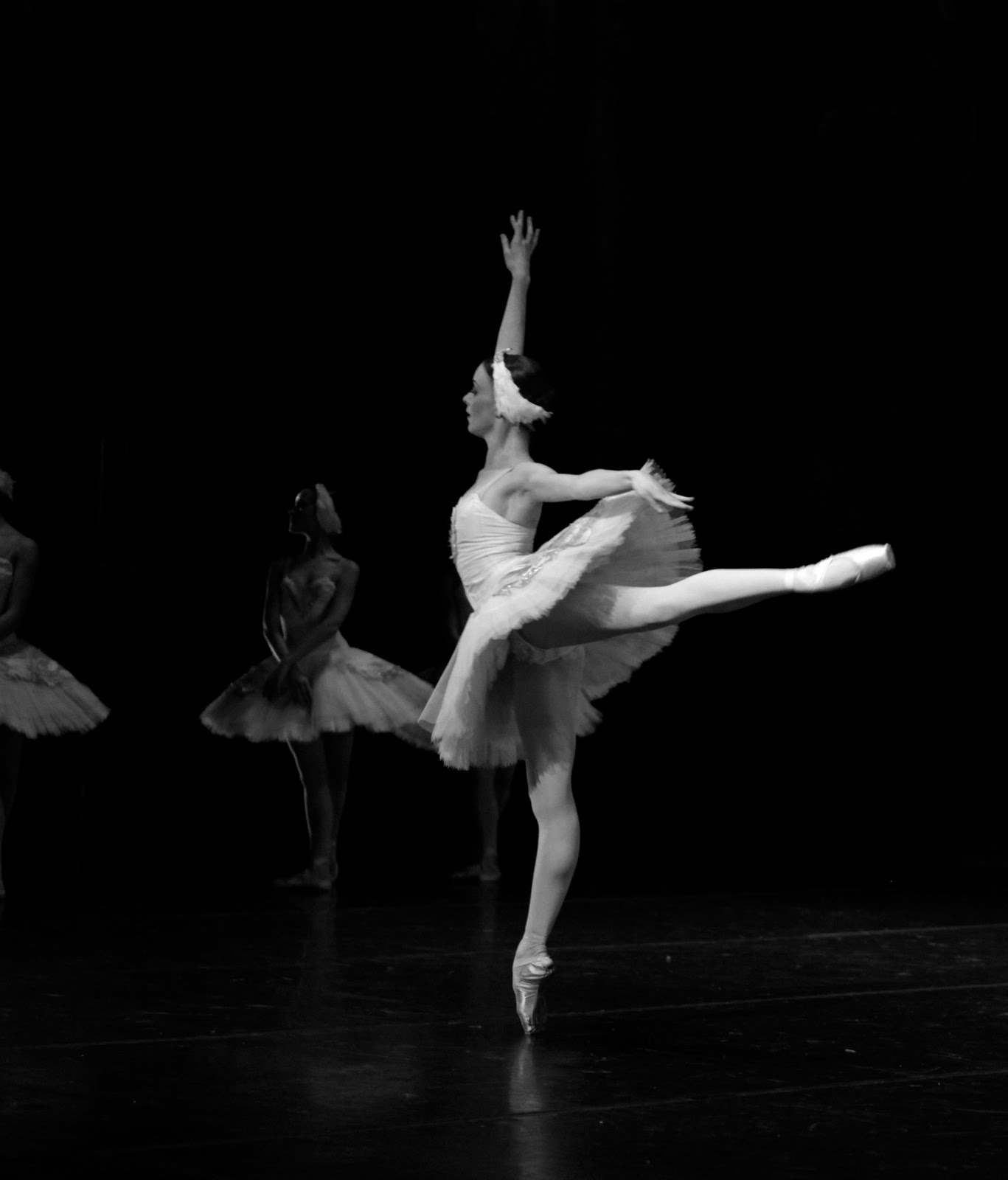
Tracy Jones dancing 'Big Swans' in Swan Lake with Corella Ballet
photograph :  Fernando Bufala

Back to the lace fabric I mentioned earlier. For ENB’s last staging of Swan Lake in-the-round in 2007, the Wardrobe department sourced a lace fabric made in a feather shaped pattern, which was bonded onto a silver lame fabric, giving a shadow and a shine. This was appliquéd onto the top skirt of the tutu along with Coque feathers (from the tail of a White cockerel for Odette) giving an overall effect of sparkling feathers.


The Company had bought & used all of the lace available in 2007. However, when preparing for this staging they discovered that the lace could not be sourced from anywhere. In the intervening years and unbeknown to them, the manufacturers had gone bust and all the machines in India had been smashed. What that means for this year is that all of the lace from the old costumes has had to be painstakingly unpicked and then sewn onto the new tutus. This work has been outsourced and is difficult because it’s not always possible to wash tutus between performances (because of their intricate design) and the dancers often spray their legs and feet with hairspray which gets onto the fabric, making it sticky and hard to separate.

"Tutus can be the enemy of a male dancer. They cut the ballerina in half so they block your view from the waist down.  Because of this issue we practice any sort of pas de deux that requires a tutu in the studio with a practice tutu. So this way the male dancer can feel the ballerinas balance and weight. What I like about tutus is that they are the "classic and essential element" of any classical ballet just like a pointe shoe, without it ballet would not have the same beauty and elegance!"
Sabi Varga, Soloist, Boston Ballet

Odile’s black tutu is decorated largely with jewels that sparkle under the stage lights, but, this being Swan Lake, she will also have some special feathers. These are also tail feathers, this time from a Bronze cockerel, which are over-dyed black on the underside and are particularly prized for the topside which has a green, iridescent sheen that ENB call ‘oil-slick’ because it perfectly describes the effect. It is something that cannot be reproduced by dyeing.

Cockerels produce around 15 long, flat feathers per tail, and they are easy to produce in large numbers. The feathers can be cut to any length, making them very versatile. There are three types of Cockerel producing different coloured feathers – White, Bronze and Chinchilla.

English National Ballet's Swan Lake tutu'd dancers

Swan feathers are never used, partly because they are too large (the tutu is decorative not indicative), but also because Swans are protected in the UK under the Wildlife and Countryside Act 1981 which makes it illegal to take the wild birds, the nests or their eggs. Unmarked swans in England traditionally belong to the Monarch, but there are some on the Thames that belong to the Guild of Vintners and the Guild of Dyers. The famous Abbotsbury Swannery provides feathers to The Plumery and these come from moultings.

During the Bird Flu outbreak which began in 2003 in South East Asia, the supply of feathers was threatened. Most of the feathers coming into the UK are imported from China, South Africa, Poland, Turkey and Israel – largely countries were a lot of chicken is consumed as the feathers are a by-product. No feathers could be imported from affected regions (though neighbouring non-affected regions were fine), and strict conditions were imposed. Vet and sterilization certificates would be checked with the feathers and if any failed to meet the stringent criteria they were destroyed.

English National Ballet Swan Lake tutu

"I absolutely love dancing in a tutu - it is the quintessential ballerina costume! My favorite tutu I have ever worn would have to be any of the three Aurora tutus from the Sleeping Beauty. Here's a tip - if you are going to be performing in a tutu, try and rehearse in a practice one. It makes such a difference not only in the way you hold yourself but also for your partner. A tutu adds difficulty to partnering, so the guys are always happy when we are able to wear one in rehearsals. Think about it - a shoulder sit is a lot different with 8 layers of tulle!"
Kathryn Morgan, Soloist, New York City Ballet

Some dancers love tutus, and some find them uncomfortable and restrictive. Not being able to see your legs and feet takes some getting used to, and in a ballet such as Swan Lake, where the ballerina is very much “on her legs”, she relies more on her partner for balance. For her partner too, the tutu presents challenges. Most of the decoration will be placed on the top skirt but avoids the waistline, giving her partner a safe place to hold her so that his hands are not torn to shreds. He still has to watch out for his face though, as the stiff net layers can scratch the skin.

That said, there is nothing like a tutu to make a dancer feel like a ballerina. Along with pointe shoes, a tutu really is the unique tool of her trade.

“I like tutus, if they are well made and fit the girl properly. I like the way the bodice feels in my hand. Though that being said bodices with beading etc. can sometimes cut you up a bit! There is a feeling of security for some reason, probably because a tutu doesn't (or shouldn't) move around when you are partnering. The costume is exactly where your partner is. In the beginning though I had a little trouble with overhead lifts, not because they were physically more difficult with a tutu, but because you have to be very aware of the angle of the costume from the front of house. After a few shows though, I reworked my hand positions a bit, so my ballerina would not be caught in a position that could be described as untowards!”
Tyler Angle, Principal, New York City Ballet


English National Ballet has generously offered a unique prize to celebrate their 60th Birthday Year and the 60 Swans in Swan Lake.

To begin with, I have 2 tickets to Swan Lake in-the-round at the Royal Albert Hall this month. Then, at the beginning of the new season in late August, you will be invited to spend an afternoon at ENB headquarters in London, visiting the wardrobe department, watching a rehearsal and meeting some of the dancers. Finally (subject to availability) a professional photographer will document your visit to ENB as a memento for you to keep, and your visit will be featured here in BALLET NEWS. 


To be in with a chance of winning this fabulous & unique opportunity, all you need to do is correctly answer the following question :

What date does English National Ballet celebrate its 60th Birthday ?

Please leave your answer in the comment form below along with your contact details. The closing date is Friday 11th June 2010 at 5pm GMT. The winner will be chosen at random from the correct answers after the closing date and notified immediately.

You must make your own travel arrangements and this prize does not cover any expenses incurred.

Please note that the 2 tickets are available for one of the following performances/casts (subject to availability), so please make sure that you are available at short notice :

Sunday 13 June at 2.30pm
Elena Glurdjidze, Arionel Vargas, Tamas Solymosi

Tuesday 15 June at 7.30pm
Polina Semionova, Vadim Muntagirov, Tamas Solymosi

Wednesday 16 June at 7.30pm
Elena Glurdjidze, Arionel Vargas, Tamas Solymosi

Wednesday 16 June at 1.50pm (Schools' Matinee, not open to the public)
Begona Cao, Esteban Berlanga, Tamas Solymosi

Thursday 17 June at 7.30pm
Daria Klimentová, Vadim Muntagirov, Tamas Solymosi

Friday 18 June at 7.30pm
Elena Glurdjidze, Arionel Vargas, Tamas Solymosi

Saturday 19 June at 2.30pm
Erina Takahashi, Dmitri Gruzdyev, Tamas Solymosi

Saturday 19 June at 7.30pm
Daria Klimentová, Vadim Muntagirov, Tamas Solymosi

Here is a video of Swan Lake.

This is a video clip of Polina Semionova, who Guests in Swan Lake, dancing with Vadim Muntagirov.  Toegther they will open the run of performances on June 9th.  To book tickets, please contact the Royal Albert Hall Box Office.

Good Luck  everyone !

Saturday, 8 May 2010

Corella Ballet tour to New York update with Tracy Jones


Not long ago I interviewed Tracy Jones, who is a dancer with Corella Ballet in Spain. The Company were about to tour to the US for a week, performing at the New York City Centre. Their Artistic Director, Ángel Corella, was a Principal with American Ballet Theatre, and so very well-known to US audiences. In 2001, Spanish born Corella formed a Foundation to promote classical dance in Spain and to offer the opportunity for the finest professional training to all dancers, irrespective of background. After six years, the Corella Ballet was formed at the Royal Place of La Granja in Segovia, Spain.

Tracy Jones and Ivan Sanchez in DGV -Danse à grande vitesse
Photograph :  Rosalie O'Connor courtesy of Corella Ballet

One of the ballets which the Company were due to perform was Christopher Wheeldon’s DGV -Danse à grande vitesse, which premiered in 2006 at the Royal Opera House, London, with Darcey Bussell famously in the principal role and partnered by Gary Avis.  This was to be their New York premiere.

For DGV, Tracy was 3rd cast and had been rehearsing it with Chris Wheeldon. Tracy hopes that once the Company begin performing performing DGV more frequently, she may have a chance to do it, but for now she feels that it’s a privilege just to even learn it.

The tour was a huge success, with great reviews.

Tracy in Times Square, New York

I caught up with Tracy once the tour was over, to find out more.

What was your preparation for the New York tour ?
The schedule at work was pretty busy in the last the few weeks before heading out to New York as we were rehearsing the rep that we were planning to do out there as well as premiering the company's Swan Lake for the first time. One of the ballets; Wheeldon's DGV was also a company premiere due to be performed in NY so it was tough trying to process all the information and get all the steps in to my head but we were lucky to have Jason Fowler and Chris himself working with us very closely throughout the process.

What was your first impression on landing in New York (if this was your first visit)?
I fell in love! It is such a wonderful city. We had been travelling all day and arrived in the evening, so we were pretty tried but I didn't want to waste any time out there. On the first evening, I already got to see some of the main sights I had planned on visiting. The jet lag didn't even get to me out there really as I was so full of adrenaline.

What was the Company due to perform ?
The company were due to perform String Sextet by Angel Corella, Solea by Maria Pages and DGV by Christopher Wheeldon at all the shows. In the evening shows, there were also two divertissements; Black Swan Pas de Deux and Walpurgisnach, and in the matinee, Epimitheus by company dancer Russell Ducker (Editors note : more from him later).

Tracy Jones rehearsing DGV
Photograph :  Fernando Bufala

What were you scheduled to dance and did everything work out as planned ?
I performed Angel's String Sextet and DGV in each show and also performed in Epimitheus in the matinee show. Luckily for once, there was no drama during the week of shows. Normally there is always a situation where someone goes off sick or injured and a lot of people have to move around to compromise but we seemed to be lucky that week. We had been performing in Barcelona a few weeks before and the company was struck down with a virus so we had a lot of drama involving people moving around and jumping in, so I think karma was on our side for New York.

Did you get to see the sights at all ?
We were very lucky to actually have 3 days off during our time out there so I managed to see everything I wanted to see.

It was Saint Patrick's day out there on the first day and being Irish, I really wanted to see the parade and join in on the festivities. I wasn't disappointed! Everything was green and the parade was great, in fact I think it might be even bigger there than in Ireland.

I also managed to take a few classes at Steps on Broadway which was a really great experience. There were many dancers from New York City Ballet there at the same time including Wendy Whelan, Ashley Bouder and Maria Kowroski. They are all dancers I have watched and admired on youtube and videos so to take class with them was really great. Its also really refreshing to see and try a different style of dancing other than what I am used to.

I did a lot of shopping too (maybe a little too much as I don't think my bank balance was very happy by the end of the week) and got to see some of the wonderful New York nightlife. I'm lucky to have a few friends living out there so it was great to see them, and to have good tour guides!

Tracy with Jason Fowler and Chris Wheeldon backstage at the City Centre theater

What was the high point of the tour ?
I think definitely the reception that we got from the audiences out there. On the first night, we finished the show to a standing ovation and there were so many people waiting outside to meet us afterwards. I think that as we are new company and it was our first International tour; a lot was expected but the audience seemed really enthusiastic and reviews were really positive which is always a good sign.

One particular moment I loved was taking our curtain calls after the matinee show of Russell Ducker's Epimitheus. It is his first work for a company so to have it premiering at New York City Centre is a huge deal for him. I was so happy and proud of Russell when he took his bow as the audience really did go crazy for him. Russell and I have been friends since we joined White Lodge so it was really great to see him do so well and hopefully this will give him even more great opportunities.

Now you are back in Spain, what’s next ?
We are currently in rehearsal period here and have quite a number of shows coming up around Spain which is always nice, especially in the summer. Swan Lake is coming back into the programme in June which will be nice. I had my premiere of Big Swans in the last run we did, which was a pretty nerving but good experience, but of course as a dancer we are never entirely happy with everything so I'm looking forward to hopefully dancing that again and improving it. We also have some tours coming up including Italy and Mexico and have started rehearsing Raymonda so it looks like the next few months are going to be busy, but I'm really looking forward to travelling and hopefully returning to New York with the company again at some point in the future!